You invested real time and money into making your website look great. Clean design, strong visuals, a layout that feels polished. And yet the leads aren't coming in the way you expected.
This is one of the most common frustrations I hear from business owners and marketing teams. The site looks the part, but it isn't performing. The reason, more often than not, comes down to one thing: the user journey was never part of the plan.
After years of building custom web solutions for marketing teams, I can tell you that a good-looking website and a well-designed website are not the same thing. The ones that consistently generate leads, nurture prospects, and drive conversions are built around how people actually move through them.

What Is the User Journey?
The user journey is the full path a person takes when interacting with your brand online. It starts the moment they first find you (through a search result, an ad, a referral link) and continues through every step they take until they convert or leave.
Mapping the user journey means documenting those paths for different types of visitors so you can spot where people get confused, lose interest, or hit a wall, and fix those moments before they cost you a conversion.
Here is a visual overview of the five core stages most visitors move through:
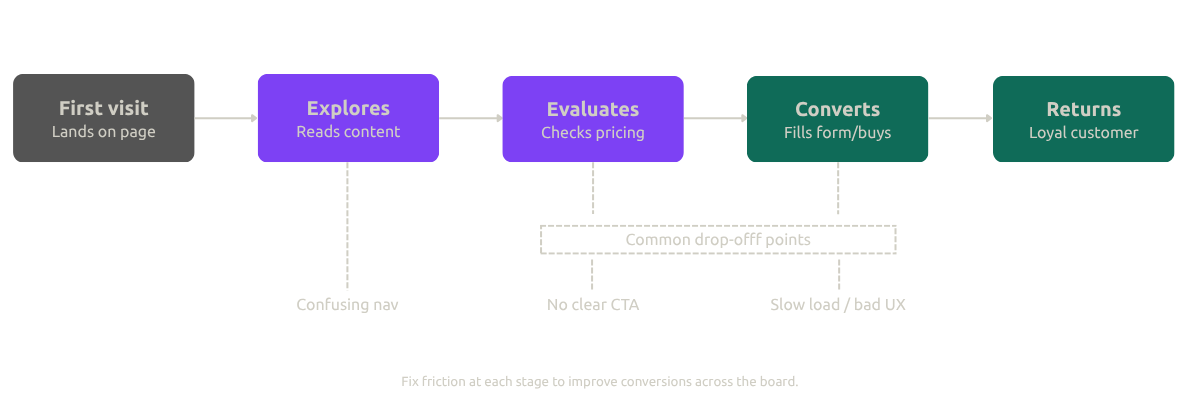
Every stage above is a place where your website either earns or loses that visitor's trust. The ones that do it well are not necessarily the prettiest. They are the clearest.
Why a Pretty Website Is Not Enough
Think about the last time you landed on a visually impressive site and still left frustrated. Maybe the menu made no sense. Maybe you could not find the pricing. Maybe the contact form asked for ten fields when you just wanted to ask one question.
That experience is more common than most businesses realize, and it is quietly costing them leads every single day.
When visitors land on your site, they are not there to admire the design. They have a goal: find an answer, compare options, solve a problem. If your site gets in the way of that goal, they leave. It does not matter how good it looks.
This is why user experience (UX) design is so central to marketing success. UX is not just a visual discipline. It is the practice of understanding what your visitors need and building a website that gets them there without friction.
4 Reasons the User Journey Directly Impacts Your Marketing Results
1. It puts your audience first, not your brand
Good marketing starts with understanding what your customers actually want. A user-centered website asks the right questions before a single pixel is placed.
What problem brought them here? What are they hoping to find? What would make them feel confident enough to reach out or buy?
By mapping out the paths different segments of your audience take through your site, you can design for their needs rather than for internal preferences. That shift in perspective changes everything about how a website performs.
2. Simplicity drives conversions
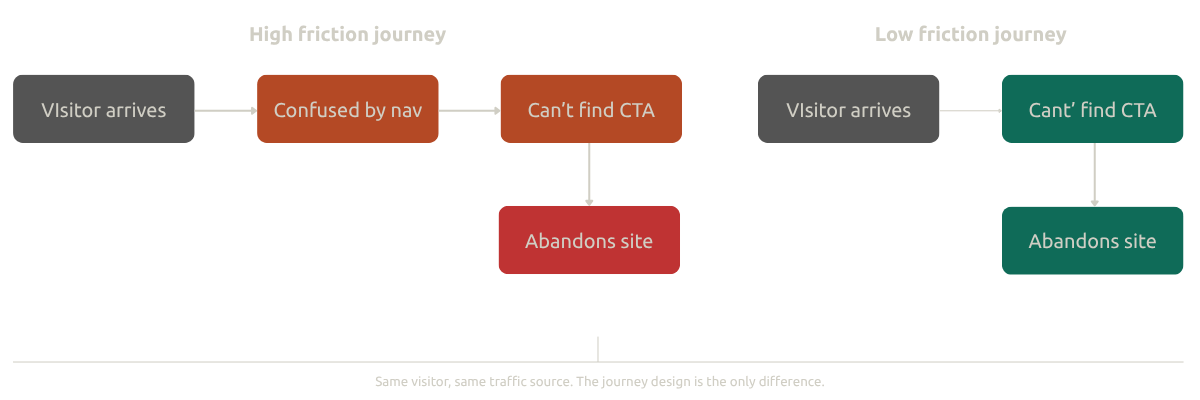
People are busy. They are not going to spend five minutes trying to figure out how to contact you or what your service actually does. Every unnecessary click, every confusing menu, every buried call to action is a chance for them to give up and go elsewhere.
A well-designed user journey removes those obstacles. It makes navigation obvious, keeps calls to action visible and clear, and shortens the path from "I'm interested" to "I'm ready to act." The result is higher conversion rates without spending more on traffic.
Here is what the difference looks like in practice:
3. A smooth experience builds trust
Your website is often the first real interaction someone has with your business. And just like a first meeting in person, the impression it leaves matters a lot.
A site that is hard to use signals something is off, whether that is lack of care, lack of professionalism, or just lack of attention to detail. A site that is easy to use signals the opposite. It says you respect your visitor's time, you have thought about their needs, and you run a tight ship.
That trust compounds. Visitors who feel confident in the experience are more likely to fill out a form, make a purchase, or recommend you to someone else.
4. UX directly supports SEO and AEO performance
This one surprises people, but it should not. Search engines measure how people behave on your site, not just what your site says.
If visitors bounce quickly, Google takes note. If they spend time reading and clicking through to other pages, Google takes note of that too. Page speed, mobile responsiveness, clear structure, and low bounce rates are all UX factors that influence where you rank.
For AEO (Answer Engine Optimization), the connection is even tighter. AI-powered answer engines like Google's AI Overviews favor pages that are clearly structured and answer questions directly. If your content is organized around real user questions, with clean headings, logical flow, and easy-to-scan answers, it is far more likely to be pulled into those featured responses.
Good UX and good search performance are not separate strategies. They reinforce each other.
The Most Common User Journey Mistakes That Kill Conversions
Here are the issues I see most often when auditing websites for clients:
Buried or unclear calls to action. If a visitor has to hunt for your contact form or booking button, you have already lost most of them. CTAs need to be visible without scrolling, worded clearly, and repeated at logical moments throughout the page.
Navigation that requires guesswork. Menu labels like "Solutions" or "Our World" sound creative but they tell visitors nothing. Use plain language that matches what people are actually looking for.
Forms that ask for too much. Every extra field you add to a form reduces the chance someone completes it. Only ask for what you genuinely need at that stage of the relationship.
Pages that load too slowly. A one-second delay in load time can reduce conversions by 7%. On mobile, the impact is even worse. Speed is not a technical nicety, it is a conversion lever.
No clear value proposition above the fold. When someone lands on your homepage, they should know within five seconds what you do, who you do it for, and what they should do next. If that is not immediately clear, most people will not stick around to find out.
How to Start Improving Your User Journey Today
You do not need a full redesign to make meaningful improvements. Here is a practical place to start.
Walk your own site like a stranger would. Pick one key conversion goal (a contact form submission, a demo booking, a purchase) and navigate to it as if you had never seen your site before. Make a note of every moment of confusion or hesitation.
Ask someone else to do the same. You are too close to your own site to see it clearly. Watch a colleague or a friend try to complete a task, and do not say a word. Just observe where they pause or get lost.
Use data to find the biggest drop-offs. Google Analytics shows you where people exit. Heatmap tools like Hotjar show you where they click and scroll. Session recordings let you watch real users in action. Between these tools, the friction points become very visible very quickly.
Prioritize the highest-traffic, highest-intent pages first. You do not need to fix everything at once. Start with the pages where the most potential conversions are happening (or not happening) and work from there.
Frequently Asked Questions About the User Journey
The user journey is the path a visitor takes through your website from the moment they arrive to the moment they convert or leave. It covers every page they view, every decision they face, and every obstacle they encounter along the way.
UX (user experience) is the broader discipline of designing products that are useful and enjoyable. The user journey is one specific tool within UX: it maps out the actual steps a person takes so you can identify where the experience breaks down.
Search engines like Google measure signals like bounce rate, time on page, and mobile usability to assess quality. A well-designed user journey keeps people engaged longer and signals to Google that your site is worth ranking. Structured, easy-to-navigate content also performs better in AI-generated answer results.
High bounce rates, low time on page, poor form completion rates, and visitors dropping off at the same pages consistently are all signs. If your analytics show people leaving before reaching your CTA, the journey has friction that needs fixing.
Not necessarily. A dedicated UX designer brings expertise and speed, but anyone can start with the basics: walking the site themselves, gathering feedback from real users, and using free analytics tools to find where people are dropping off. Many high-impact fixes are straightforward once you know where to look.
More than half of web traffic now comes from mobile devices. If your site is hard to use on a phone (small tap targets, slow load times, text that requires zooming) then a large portion of your visitors are having a frustrating experience before they ever engage with your content. Mobile optimization is not optional if you want the journey to work.
Simplify. The less a visitor has to think about where to go or what to do next, the more likely they are to get there. Start with your primary CTA and work backwards: is every step leading to it as clear and frictionless as it could be?
The Bottom Line
A website that looks great but functions poorly is not a marketing asset. It is a very expensive brochure that most people leave without reading.
The user journey is what transforms a website from something that exists into something that works. When you design around how your visitors actually think and move, everything improves: the experience, the trust, the SEO, and ultimately the conversions.
Start with one path. Walk it yourself. Fix one thing. Then keep going.