If you have searched on Google recently, you have probably noticed something different at the top of the page. Before any traditional blue links appear, there is now a box labeled "AI Overview" that hands you a ready-made answer. That is not a coincidence or a beta test anymore. It is Google's new normal, and if your business depends on organic traffic, it changes everything about how you need to think about content.
What Exactly Is AI Overview?
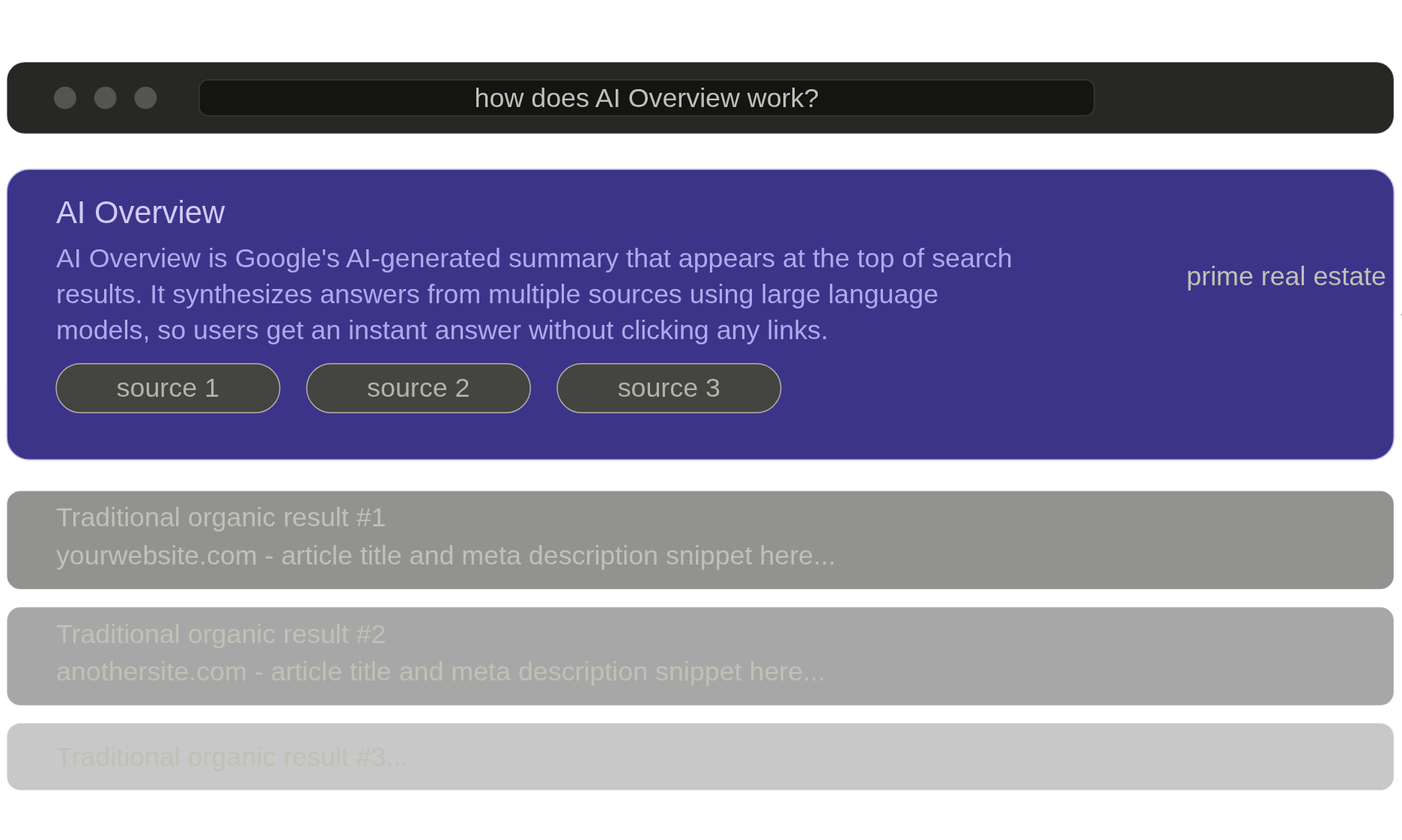
AI Overview is a feature built directly into Google Search that generates a concise, AI-powered summary in response to a query. It sits at the very top of the search results page, above every traditional organic listing. Instead of presenting users with a ranked list of links and letting them decide where to click, Google now synthesizes an answer on the spot, pulling from multiple sources across its index.
The engine behind it is Google's Gemini, a large language model capable of understanding the intent behind a search, not just the words. AI Overview was previously called Search Generative Experience (SGE) when it was in experimental mode. Today it is widely deployed, and for many query types, it is the first thing users see and engage with.
Think of it this way: Google is no longer just a librarian pointing you toward the right shelf. With AI Overview, it is reading the books for you and summarizing what they say.
Is AI Overview Actually Useful for Searchers?
For users, the appeal is obvious. Most people searching for information want a fast, direct answer. AI Overview delivers exactly that for a wide range of informational queries. Someone asking how a medical term works, what a historical event means, or how to troubleshoot a common tech issue can get a usable answer in seconds without opening a single website.
There are real benefits here. AI Overview pulls from multiple reputable sources and synthesizes them into one coherent response, which is something a traditional SERP has never been able to do on its own. The experience feels more like talking to a knowledgeable colleague than running a keyword search.
That said, it is not a perfect replacement for traditional search results. For transactional searches like "buy standing desk" or "book a flight to Miami," users still need to visit a website. For research-heavy topics, many users still want to read the original sources, verify claims, and explore perspectives that a summary might miss. And like all generative AI, AI Overview is not immune to errors. Occasional inaccuracies, sometimes called hallucinations, do surface, though Google continues to refine the system.
The honest takeaway for a marketer is this: AI Overview is excellent at answering questions quickly, and that is precisely why it is so disruptive to traffic patterns.
The Real Impact on Organic Search Traffic
Here is where it gets important for anyone running a content-driven website or managing an SEO strategy.
When a user gets a complete answer directly on the SERP, they have no reason to click through to your site. This is the "zero-click search" problem, and AI Overview has made it significantly worse for informational content. Studies tracking post-AI Overview traffic have shown measurable declines in click-through rates, particularly for non-branded, informational queries where Google can synthesize a complete answer without requiring additional context.
For businesses that built their organic presence around top-of-funnel, educational content, this is a real shift in the economics of search.
However, there is an important flip side. Users who do click through from an AI Overview tend to be further along in their thinking. They have already read the summary and decided they want more. That makes them more engaged, more likely to trust your content, and often closer to taking action. So while raw traffic volume may decrease, the quality of what comes through can actually improve.
The challenge now is twofold: minimize the traffic loss where possible, and position your brand to be cited as a source within AI Overview itself.
How to Win in an AI Overview World
Getting your content featured inside an AI Overview summary is quickly becoming one of the most valuable positions in search. It is the new first-page ranking, except instead of a blue link, it is your information being presented as the answer. Here is how to think about it from a content and SEO strategy perspective.
Answer questions directly and completely. AI Overview draws from content that does the work of answering a specific question clearly and without ambiguity. If your articles bury the lead, AI has nothing useful to extract. Structure your content so the answer appears early, and then support it with depth.
Build topical authority. Google's AI is more likely to cite sources it recognizes as authoritative on a topic. This means consistently publishing well-researched, accurate content within a defined subject area rather than spreading thin across many unrelated topics. The E-E-A-T framework (Experience, Expertise, Authoritativeness, Trustworthiness) is no longer just a guideline. In the age of AI Overview, it is the selection criteria.
Use structured data and clean formatting. Clear headings, schema markup, and logically organized content make it easier for Google's AI to extract and summarize your information. Unstructured walls of text are harder to parse and less likely to be cited.
Think in questions, not just keywords. Your audience is searching conversationally. Content that anticipates follow-up questions and provides layered answers performs better in this environment because AI Overview tends to reward depth alongside clarity.
Do not abandon informational content. Yes, zero-click searches are increasing. But being cited in an AI Overview still puts your brand in front of the user, builds recognition, and often drives branded searches later. Visibility at the answer layer still matters even when no click happens immediately.
What This Means for Your Long-Term Strategy
AI Overview is not a trend you can wait out. Google has confirmed it is subject to core algorithm updates, meaning it will only become more sophisticated and more central to how results are delivered over time. The brands and publishers who adapt their content strategies now will be far better positioned to maintain visibility than those who treat this as a temporary disruption.
The goal is no longer just ranking for a keyword. The goal is becoming the source that Google's AI trusts enough to cite when a user asks a question that matters to your business. That requires better content, clearer expertise, and a deeper understanding of what your audience actually wants to know.
The search landscape has shifted. AI Overview is not coming. It is already here, already influencing how millions of people access information every day. The question is whether your content is built to show up in it.
Frequently Asked Questions
AI Overview is a Google Search feature that generates an AI-powered answer at the top of search results, synthesizing information from multiple sources using Google's Gemini language model. It was previously called Search Generative Experience (SGE).
It uses a large language model to interpret the intent behind a search query, then pulls relevant content from Google's index to create a summarized response. It also cites the sources it draws from.
It has been rolling out broadly and is now integrated directly into mainstream search results for most users in supported regions, no longer limited to an opt-in experiment.
They are generally accurate but not perfect. Like all generative AI systems, AI Overview can occasionally produce minor errors. Google continues to work on improving reliability.
No. Traditional organic listings still appear below AI Overview and remain important for transactional, navigational, and in-depth research queries. AI Overview complements rather than replaces them.
Focus on clear, authoritative, well-structured content that directly answers common questions in your topic area. Strong E-E-A-T signals, structured data, and consistent topical depth all increase the likelihood of being featured.
Yes. Click-through rates for informational queries have declined as more users find their answers directly on the SERP. However, traffic that does come through from AI Overview citations tends to be higher quality and more engaged.
Absolutely. SEO strategy needs to evolve beyond keyword rankings toward content that is clear, authoritative, and optimized for how AI systems extract and present information to users.