If you've spent any time talking to an SEO or a web developer over the past few years, you've probably heard the phrase "Core Web Vitals" thrown around like it's obvious what it means. It isn't, and that's a problem, because these three metrics quietly shape how Google sees your site and how people actually experience it.
Let's break it down in plain terms.
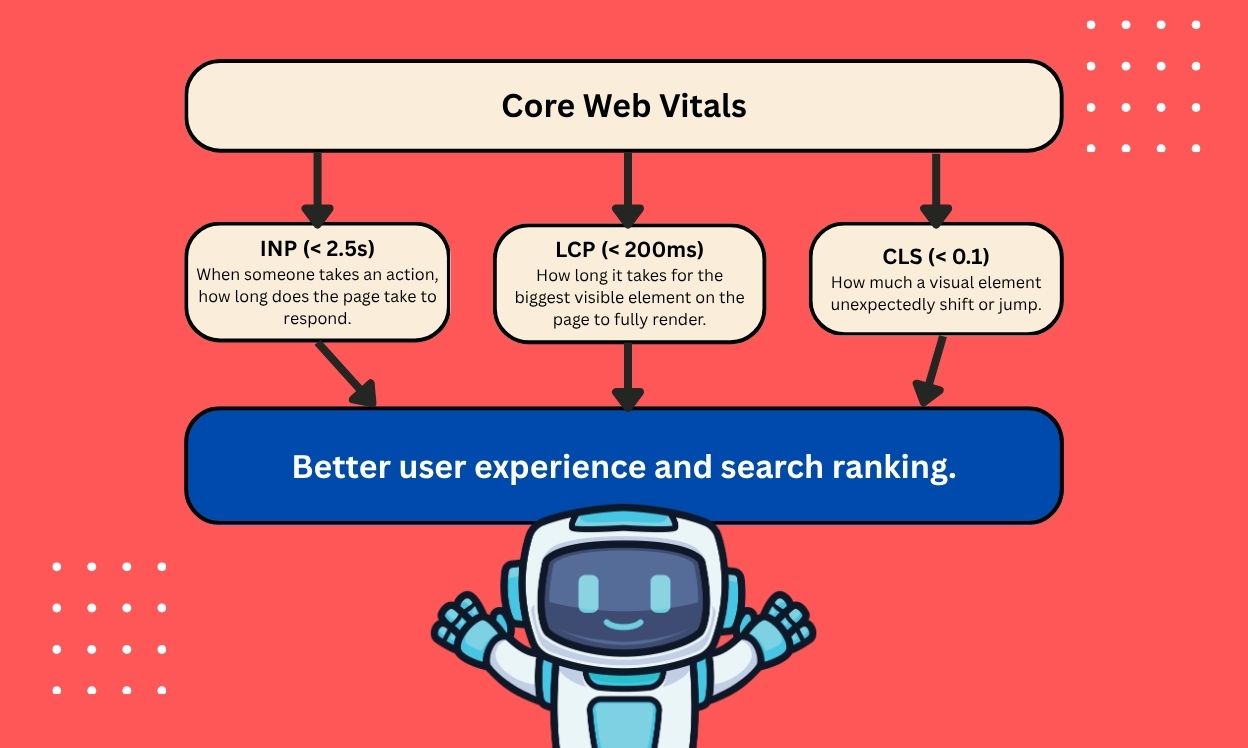
Core Web Vitals, defined simply
Core Web Vitals are a set of three measurable signals that Google uses to judge how good a webpage feels to use. Not how good it looks in a mockup. Not how clever the code is. How it actually feels when a real person lands on it, on a real device, often on a mediocre internet connection.
The three metrics are:
Largest Contentful Paint (LCP) measures loading speed. Specifically, how long it takes for the biggest visible element on the page, usually a hero image or a headline, to fully render. Google considers anything under 2.5 seconds good.
Interaction to Next Paint (INP) measures responsiveness. When someone clicks a button, taps a menu, or fills out a form, how long does the page take to respond? Anything under 200 milliseconds is considered good. This metric replaced First Input Delay in 2024, so if you've seen older articles referencing FID, that's outdated.
Cumulative Layout Shift (CLS) measures visual stability. This is the metric behind that annoying moment when you go to tap a button and the page jumps, so you end up clicking an ad instead. A CLS score under 0.1 is considered good.
Why marketers should actually care about this
Here's where a lot of businesses miss the point. Core Web Vitals aren't just a technical checkbox for your dev team to handle in isolation. They're a direct reflection of user experience, and user experience is now inseparable from search performance.
Google has been public about the fact that page experience, including these three metrics, is a ranking factor. It's not the single biggest one. Content relevance, backlinks, and search intent still carry enormous weight. But when two pages are competing for the same keyword and one loads fast and feels smooth while the other stutters and jumps around, Vitals can be the tiebreaker.
There's also a second, less talked about reason this matters right now. As AI-generated answers and AI search assistants pull content to summarize and cite, they tend to favor sources that are fast, stable, and easy for crawlers to parse cleanly. A site plagued by layout shifts and sluggish load times isn't just annoying to humans, it's harder for machines to reliably extract and trust. If you're trying to show up in AI Overviews or chatbot citations, technical health is part of that equation now too.
And beyond rankings entirely, there's the business case. Slow, janky pages lose visitors before they ever convert. Every extra second of load time chips away at engagement and revenue. Core Web Vitals essentially quantify the cost of a bad experience in numbers Google, and your bottom line, both respect.
How to actually check your scores
You don't need to guess at any of this. Google gives you free tools to see exactly where you stand.
PageSpeed Insights will show you real, field-measured data from actual Chrome users who've visited your site, plus a lab-based simulation. Search Console has a dedicated Core Web Vitals report that groups your URLs by performance, so you can see patterns across your whole site rather than checking page by page.
If your scores are landing in the "needs improvement" or "poor" range, common culprits include unoptimized images, bloated JavaScript, third-party scripts (think chat widgets, ad networks, tracking pixels), and web fonts that aren't loading efficiently.
The strategic takeaway
Think of Core Web Vitals less as a technical hurdle and more as a trust signal. A fast, stable page tells both Google and your visitors that you've built something worth their time. In a competitive search landscape where content quality alone isn't always enough to separate you from the pack, page experience is one of the few levers that's fully within your control.
If you haven't audited your site's Core Web Vitals in the last few months, it's worth doing now. Search algorithms evolve, user expectations get less patient every year, and the sites that win long term tend to be the ones that treat performance as part of their content strategy, not an afterthought bolted on at the end.