Most B2B marketing teams are sitting on a revenue problem they are trying to solve with the wrong tool. They buy more traffic, launch more campaigns, and add more channels, all while the real issue sits quietly on their website: the visitors they already have are not converting into qualified pipeline.
That is the problem B2B conversion rate optimization (CRO) is built to solve. Not more traffic. Better outcomes from the traffic you already own.
Why B2B Conversion Rate Optimization Is Different From Ecommerce CRO
B2B buying is not a solo act. The average B2B buying committee has grown to 6.8 stakeholders in 2026, up from 5.1 in 2023, meaning your website content needs to speak to procurement, IT, finance, end users, and executives, each with different concerns and different conversion triggers.
That complexity changes everything about how you approach optimization. In ecommerce, you optimize for a single buyer making an emotional, often impulsive decision. In B2B, you are optimizing for a committee of skeptical professionals with budget accountability, internal approval processes, and a research phase that can last months before they ever fill out a form.
The average B2B sales cycle sits at 11.3 months, with 70% of that time spent in anonymous research before any vendor contact is made. Your website is doing conversion work long before a lead identifies themselves. That means your CRO program has to account for buyers who are learning, evaluating, and deciding without ever raising their hand.
The Real Cost of Ignoring B2B Conversion Rate Optimization
Here is the number that should get every demand gen leader's attention: on average, only 1.7% of website visitors across all industries convert, leaving the vast majority of potential revenue untapped.
For B2B teams, the problem compounds. If your MQL-to-SQL conversion rate is below 15%, your lead scoring is likely broken, and a single sales rep can waste 4 to 6 hours per day sorting through unqualified leads. That is not a sales problem. That is a marketing problem, and it starts on your website.
In 2026, the era of growth at all costs has been firmly replaced by a focus on capital efficiency, pipeline velocity, and revenue attribution. The days of celebrating high-volume, low-intent MQLs are over. The teams winning pipeline are the ones optimizing for quality, not just quantity.
What a Real B2B CRO Program Looks Like
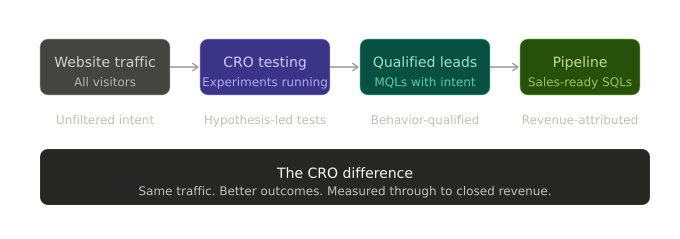
Most companies run a few A/B tests, redesign a landing page, and call it a program. Real CRO is structured experimentation: research, hypothesis formation, statistical-significance testing, iteration, and measurable revenue lift. The distinction matters because without that structure, you end up testing endlessly and learning very little.
A proper B2B conversion rate optimization program has four components working together.
Research before testing. Every experiment should begin with a hypothesis rooted in actual buyer behavior, not assumptions. Session recordings, heatmaps, exit surveys, and sales call transcripts are all inputs. What objections does your sales team hear most often? Where are high-intent visitors dropping off? The answers to those questions are your testing roadmap.
Conversion events tied to pipeline, not just forms. A demo request carries different pipeline value than a whitepaper download. Your CRO program should measure experiments against outcomes that sales actually cares about: demo requests, consultation bookings, free trial activations, and high-intent content engagements like pricing page visits and ROI calculator completions.
Statistical discipline. An underpowered test is worse than no test because it gives you false confidence. Set your minimum detectable effect before launching, run tests long enough to reach statistical significance, and resist declaring winners early. Leading CRO programs run 2 to 4 concurrent tests per month and launch 20 to 50 experiments per year. That cadence is how you build compounding improvements over time.
Closed-loop attribution. Connecting ad clicks and web interactions to CRM revenue data through tools like HubSpot or Salesforce shifts focus from lead volume to pipeline and closed revenue, giving you the full picture from first touch to signed contract.
Where to Focus Your B2B CRO Experiments First
Not all pages carry equal pipeline weight. Prioritizing where you test is as important as how you test.
Your highest-intent pages deserve the most attention first. Pricing pages, product pages, and demo request forms are where qualified buyers make their final decision about whether to raise their hand. A visitor who reaches your pricing page is doing something very different from someone who bounced off your homepage. Treat them that way.
Landing pages tied to paid campaigns are their own testing environment. The intent behind a paid click is specific and often fragile. Message mismatch between your ad and your landing page is one of the most common reasons B2B campaigns underperform, and it is one of the easiest things to test and fix.
Interactive content like ROI calculators is one of the highest-converting offer types in B2B because buyers are rational and need to justify purchases internally. A prospect who completes a calculator and sees their potential savings has already mentally committed to the value of your solution, making them far more valuable than a standard PDF download lead.
Forms are perennially undertested. Field count, field labels, the specificity of your CTA copy, and the placement of trust signals near the form all have measurable impact on both conversion rate and lead quality. "Get a demo" and "See how we cut CAC for teams like yours" are not the same ask to a skeptical buyer.
Connecting CRO to Your Marketing Pipeline: The Metrics That Matter
B2B conversion rate optimization only earns its seat at the revenue table when it is measured against the right outcomes. The metrics that matter are demo requests, qualified form fills, and pipeline contribution, not just clicks and conversion rates.
Build your reporting stack to answer these questions after every experiment: Did the winning variant increase MQL volume, SQL volume, or both? Did it change the quality of leads, as measured by MQL-to-SQL conversion rate? Can you trace the experiment's impact to pipeline value in your CRM?
Cross-functional alignment is what sustains a CRO program over time. Sharing web insights with sales and product teams, and bringing sales objections back into your copy and proof points, creates a feedback loop where each iteration gets sharper. What your sales team hears on calls is some of the best conversion research available to you, and most marketing teams never use it.
The Mindset Shift That Makes B2B CRO Work
The teams that consistently improve pipeline through conversion optimization share one characteristic: they treat CRO as an ongoing discipline, not a project with a start and end date.
Quality-focused B2B strategies respect the buyer's timeline, using content, nurturing, and relevance to guide prospects forward instead of forcing premature conversations. That same philosophy should drive your CRO program. You are not trying to trick more people into filling out a form. You are removing the friction that is stopping the right people from taking the next step.
Organizations that learn faster convert more, consistently. If your site is attracting visitors but not producing qualified conversations, the answer is not to buy more traffic. It is to make the most of the traffic you already have.
Start with your highest-intent pages. Define success as pipeline contribution. Run structured experiments. And measure every test against the outcome that actually matters: qualified opportunities in the hands of your sales team.
Ready to build a B2B conversion rate optimization program that moves pipeline? Start with an audit of the pages where your highest-intent visitors are dropping off. That is where your first experiment belongs.
Frequently Asked Questions
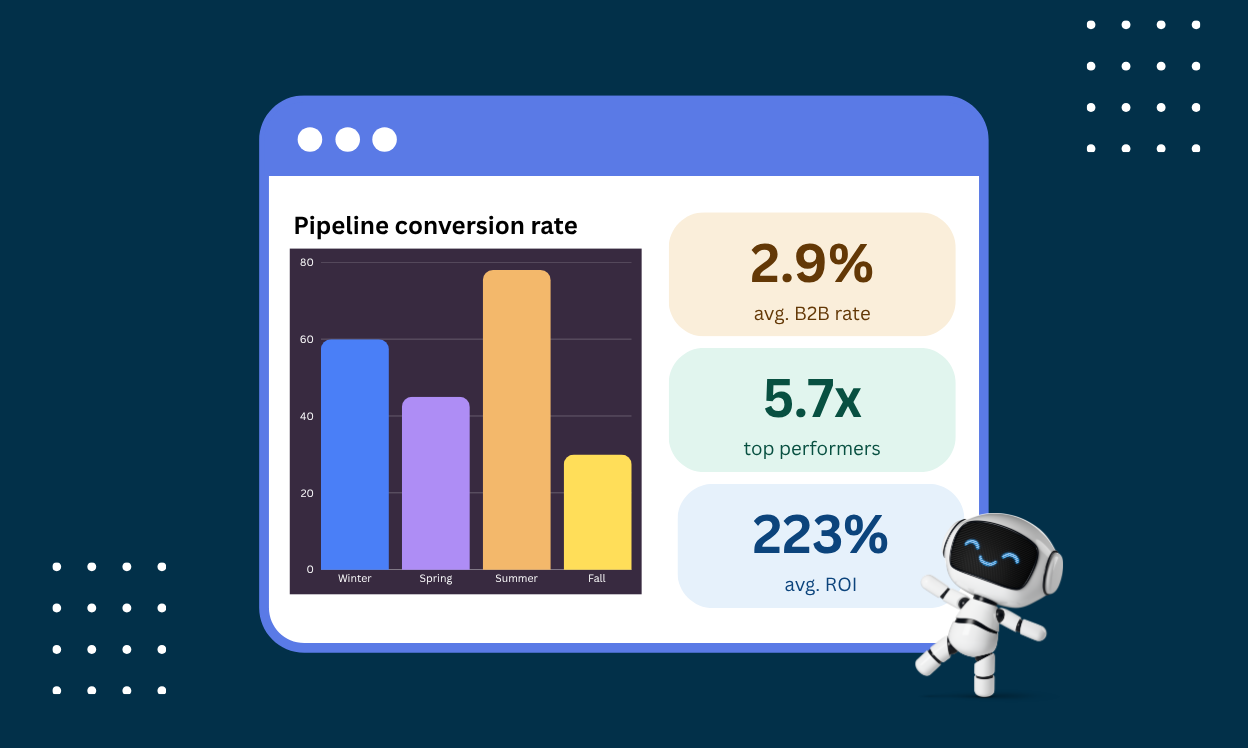
The median B2B website conversion rate sits at around 2.9%, but that number means very little without industry context. Legal services benchmark at 7.4%, B2B SaaS at around 1.1%, and manufacturing closer to 2.2%. A more useful question is whether your rate is improving quarter over quarter and whether the leads converting are actually qualified. A 1% rate that produces sales-ready pipeline outperforms a 4% rate full of unqualified form fills.
In B2B, conversions happen at the account level, not the individual user level. Multiple people from the same company may visit your site, attend webinars, and read case studies before a deal closes, so you are optimizing for account engagement across multiple sessions, devices, and stakeholders rather than a single buyer's click. B2C optimizes for an immediate transaction. B2B optimizes for the beginning of a sales process that can take months.
In order of pipeline impact: your pricing page, because visitors there have already self-qualified; your homepage, which is the first impression for most paid and organic traffic; your demo or contact page, where conversion actually happens; case study pages that move prospects from considering to deciding; and product pages where buyers self-educate before converting.
The most common B2B form mistake is asking for information you do not need at that stage. Name, email, company name, and what the prospect is trying to solve is enough to book a discovery call. Every additional field reduces form completion rate, and you can gather the rest on the call.
You will typically see leading indicators like increased form submissions and demo requests within 2 to 4 weeks of implementing changes. Revenue impact takes longer due to B2B sales cycles, usually 3 to 6 months before you have meaningful pipeline data. Quick wins like headline rewrites and form simplification can show impact faster, but a structured CRO program needs at least 2 to 3 months to produce reliable learning.
Companies that prioritize CRO see an average 223% return on investment from their optimization efforts, and top-performing teams generate 2.8x more pipeline per sales dollar than average companies, a gap that has widened significantly by 2026. The compounding nature of continuous testing is what drives those numbers, not any single test.
The strongest CRO teams link page-level behavior to pipeline outcomes by tracking how demo requests become SQLs, how SQLs become opportunities, and how those opportunities convert into revenue. This connection allows teams to prioritize fixes based on revenue impact rather than surface-level metrics like click-through rate or form fill volume. Tools like GA4 mapped to HubSpot or Salesforce CRM stages make this attribution possible.